These seven clips remain the canonical visual tour. The operating system has moved past
the captures: durable causal history, proof checks, saved lenses, a browser DAG, and the
scrub inspector are now part of the field surface.
New flagship / Window manager
The current visual artifact is wm.
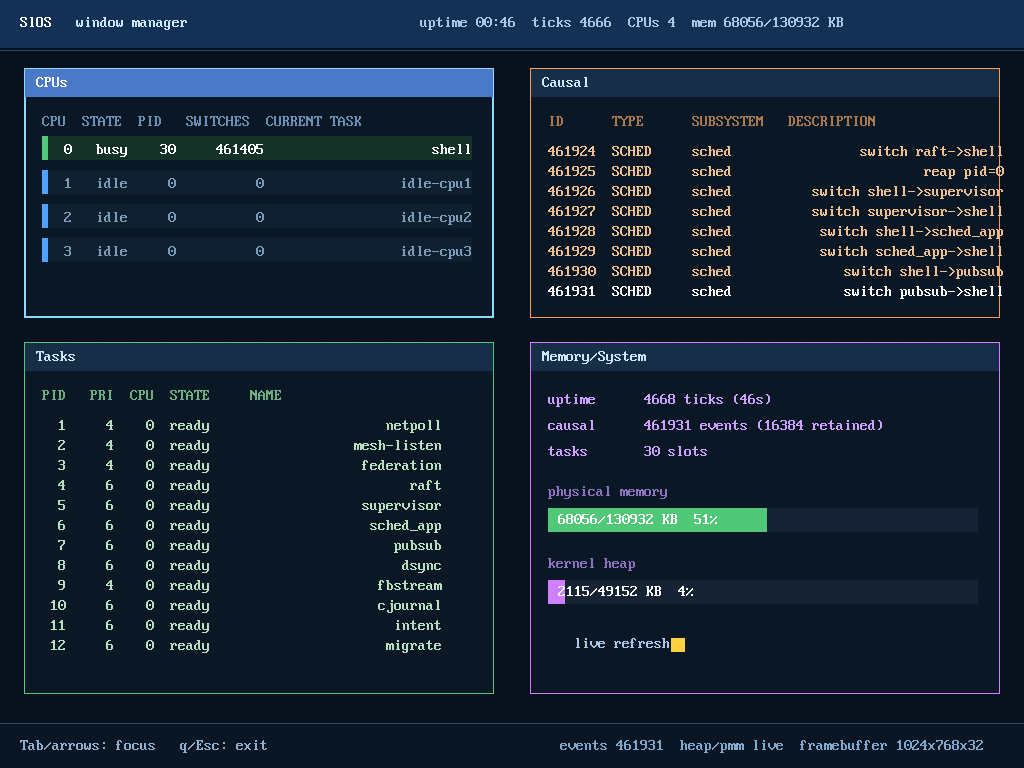
This is not a mockup: the screenshot is from the SlOS framebuffer. The window
manager uses fixed tiled panels for CPU state, a causal event tail, tasks, and
memory/system bars. It is keyboard-driven and intentionally non-composited.
wm: 1024x768x32 framebuffer, live observability panels, Tab focus, q/Esc exit.
slos:/$ wm# 1024x768 framebuffer, fixed tiled panels# CPU monitor | causal tail | task list | memory/system# Tab focuses the next panel; q or Esc exits
Full showcase
Complete showcase video. Local ticks, IDs, disk state, and peer state may differ.
01 / Boot identity
The machine enters through Multiboot, brings up x86 tables, paging, heap, interrupts, filesystems, PCI/VirtIO, network services, user programs, and the shell. The clip is the baseline: before causality is interesting, the target must boot repeatably.
02 / SlFS persistence
VirtIO block I/O backs SlFS. Disk commands write, append, inspect, and re-read files from disk.img so operator state survives outside the RAM filesystem and across QEMU restarts.
03 / Productivity
The shell is a toolbench: editor, browser, wget, file filters, simple compilation, user ELFs, and diagnostics run on the same syscall and causal surface as the rest of the kernel.
04 / External ELF and HEW
ELF inspection, installation to SlFS, argument passing, and HEW SDK examples show code entering SlOS as programs rather than only as built-in kernel commands.
05 / Timeline notes
Notes are graph-native application state. Add, tag, search, export, and replay operate over timeline events, so the current note list is a reconstruction rather than an opaque file.
06 / Actors and mesh
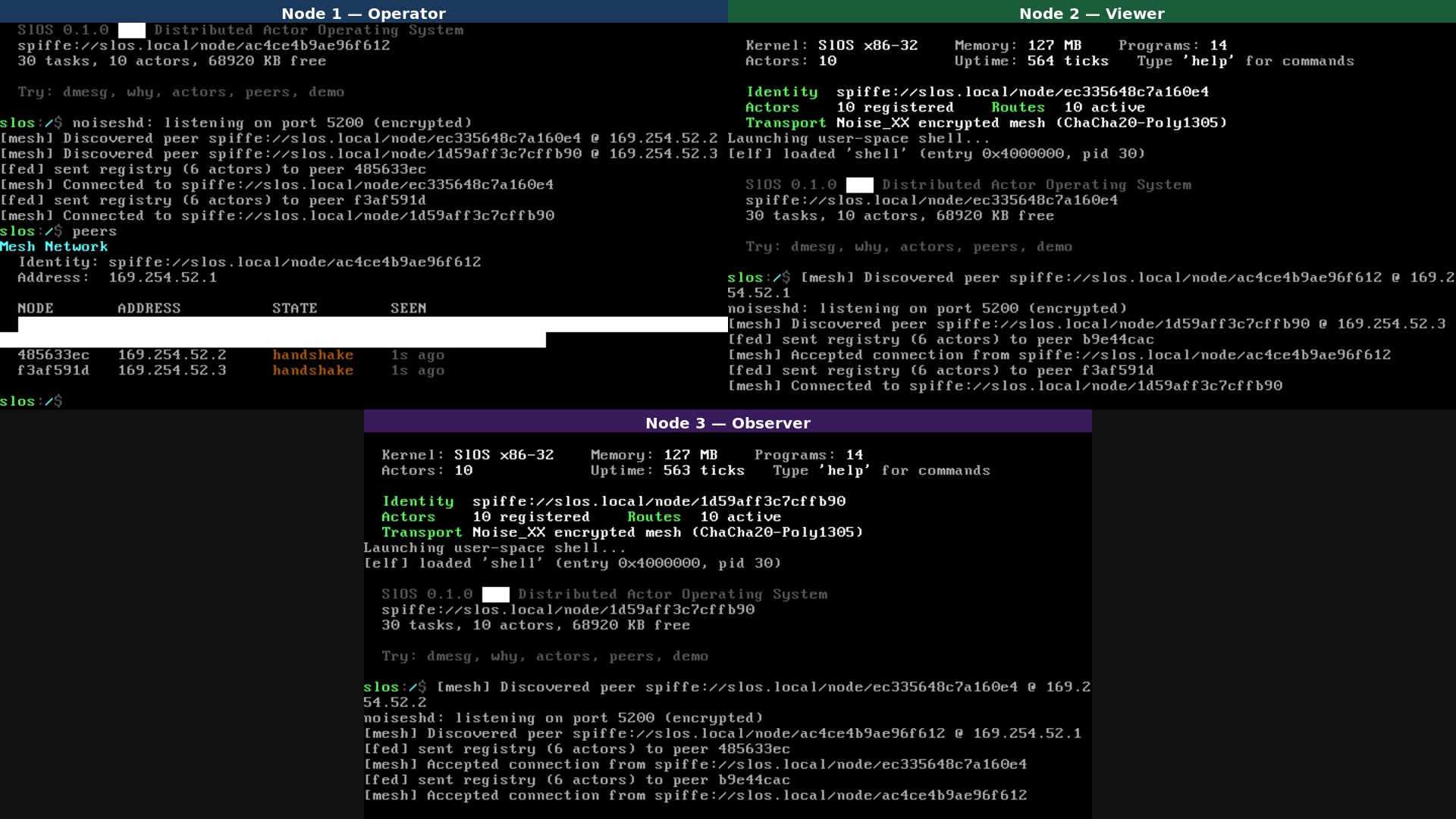
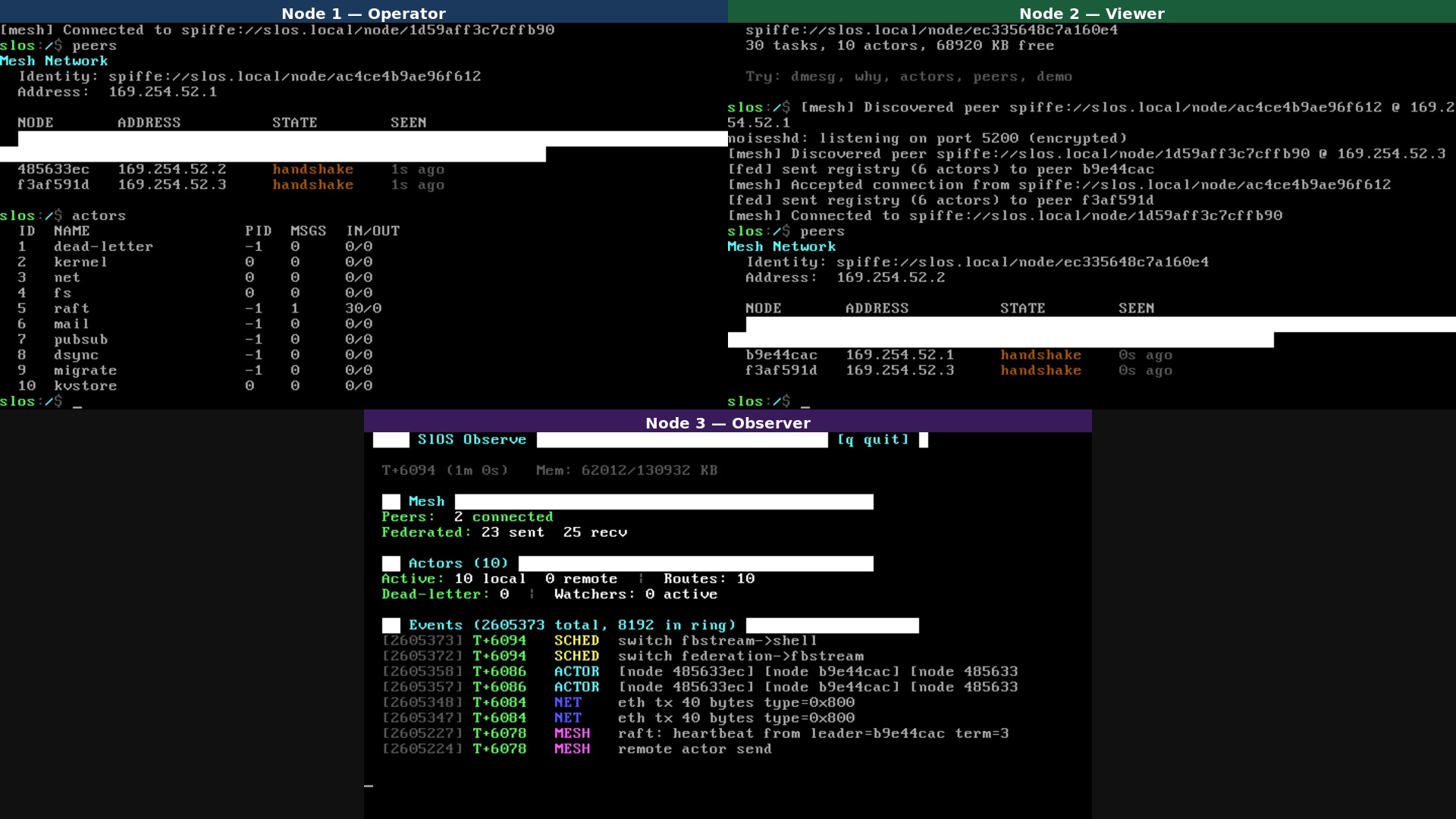
Named actors, local mailboxes, route tables, SPIFFE identity, Noise-encrypted mesh transport, and federation commands expose SlOS as a small distributed-system laboratory.
07 / DOOM
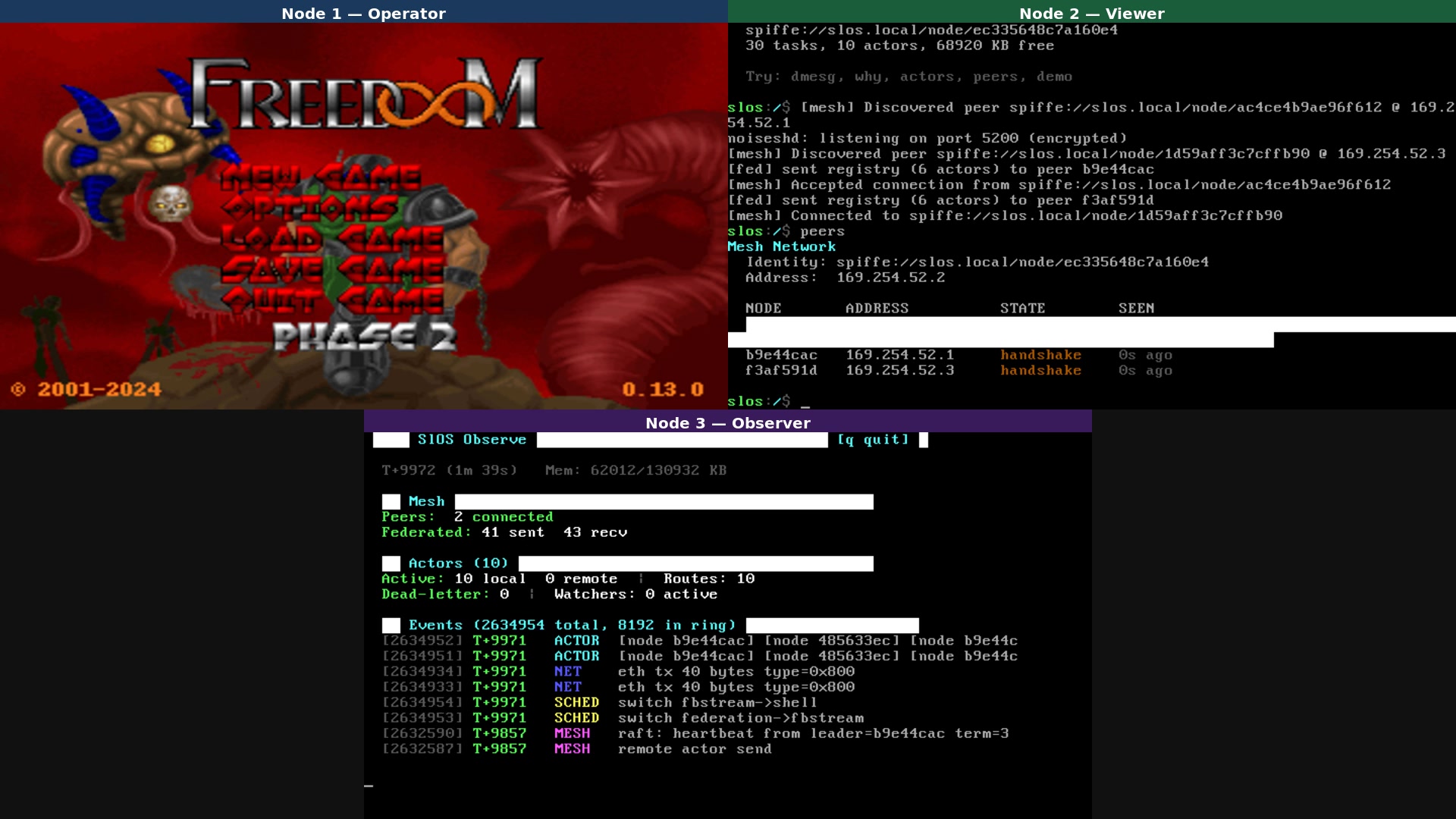
The final chapter is deliberately prosaic proof: a larger graphical program can run through the SlOS program path while the kernel remains inspectable underneath.
New plate / Remote workstation
A real work loop over TCP.
The current remote story is intentionally plain: telnetd on guest port 23
(host localhost:2323 under QEMU) and noiseshd on port 5200.
The full-screen editor works because console cursor/clear/colour become ANSI and key
input is decoded from the session stream. Files under /home persist; services
that detach, such as httpd, keep running after disconnect.
host$ telnet localhost 2323Trying 127.0.0.1...Connected to localhost.slos:/$ mkdir /home/dayslos:/$ edit /home/day/hello.sl# full-screen editor over ANSI; arrows move, Ctrl-S saves, Ctrl-Q exitsslos:/$ cat /home/day/hello.slecho hello from a remote SlOS workstationslos:/$ run /home/day/hello.slhello from a remote SlOS workstationslos:/$ httpd[httpd] Started (pid 35) -- http://localhost:8080/slos:/$ exitConnection closed.host$ curl http://localhost:8080/<!doctype html>...SlOS Explorer...
New plate / Encrypted shell
Confidential, not authenticated.
noiseshd carries the same shell stream through a from-scratch encrypted
channel: ephemeral X25519 key exchange and ChaCha20-Poly1305 messages. It is not
OpenSSH, and it does not yet authenticate the server, so active impersonation remains
a known limitation.
host$ python3 scripts/noise-shell-client.py localhost 5200# X25519 ephemeral handshake, then ChaCha20-Poly1305 frames# Current limit: no server authentication yet; confidential, not OpenSSH.slos:/$ termsize80x25slos:/$ logout
New plate / SMP auto-offload
Idle APs can take opt-in kernel work.
smp offload <n> creates unpinned, AP-safe kernel tasks. The BSP
may dispatch them to idle application processors and records the decision as
causal scheduler events. It remains cooperative and kernel-task-only.
slos:/$ smp offload 6created 6 AP-offloadable kernel tasks[ap] task ran on CPU 1[ap] task ran on CPU 2[ap] task ran on CPU 3slos:/$ cpuCPU ACTIVE CURRENT SWITCHES STATE0 yes shell 1842 busy1 yes idle/1 18 idle2 yes idle/2 17 idle3 yes idle/3 17 idle
New plate / Causal live tail
cwatch streams the graph.
The causal graph can now be watched like a log. cwatch or
cwatch tail prints recent context, then appends new events until
the operator presses a key.
chatd is an IRC-lite TCP service on port 6667: up to eight
clients, /nick, join/leave announcements, and message broadcast
through the SlOS TCP stack.
slos:/$ chatd startchatd: listening on TCP 6667host$ nc localhost 6667Welcome to SlOS chat. You are guest1./nick maple*** guest1 is now maplemaple: hello from a real TCP client
New plate / Shell pipelines
Small filters compose at the prompt.
cmd1 | cmd2 now works for shell built-ins and kernel-proxied
diagnostics. The model is honest and simple: sequential stage capture, not
concurrent POSIX pipes, with a 4096-byte intermediate buffer.
slos:/$ ps | grep raftslos:/$ events | tail -n 4slos:/$ help | grep Networkslos:/$ wc# sequential capture: each stage has a 4096-byte buffer
New plate / Web Causal Explorer
The graph can be read in a browser.
The userspace httpd serves /causal: a live SVG causal DAG
fed by /api/causal/graph, with state from
/api/causal/state. The page includes a time-travel scrubber and
click-to-focus causes/effects. No new clip exists yet, so this page records it as a
terminal plate.
scrub reconstructs state at a tick, inspects an event, emits JSON,
diffs two ticks, or asks the counterfactual impact of dropping an event. It is the
terminal companion to the browser slider.
The 551–558 toolkit reads the same event record and gives it an operator
rhythm. triage renders a one-screen verdict, cbisect
binary-searches replayable history for when a metric crossed a threshold,
cdb is a stateful debugger for causes, and cprof
profiles cause-to-effect flow across subsystem boundaries.
attest emits a self-contained Ed25519-signed receipt for one
outcome that attest verify re-checks against the node key;
capsule writes a portable incident bundle to SlFS; and
why -r tags each cause hop with its origin node.
slos:/$ attest verify lastRECEIPT VALID: event #528880 in signed segment 1; Ed25519 signature verifies against node keyslos:/$ capsule lastCAUSAL CAPSULE for event #534692 ... saved to /capsule/534692.txtslos:/$ why -r last[540525] syscall: syscall 51 pid=30 origin=local
Recent events still live in the causal ring, but the CJournal spills searchable,
read-through history to SlFS. Operators can use journal,
events -a, cq -a, why -a, proof-health
checks, and epoch/Merkle proof paths to inspect history after reboot.
Plate I -- boot services and field prompt.Plate II -- causal and timeline operation.Plate III -- DOOM showcase frame.Plate IV -- wm framebuffer desktop.