01 / Causal graph
Every significant action has parents.
Scheduler switches, syscalls, filesystem operations, packets, actor messages, mesh events, shell commands, and application events enter a typed DAG with Lamport time and parent edges.
SlOS operating manual / current field edition
SlOS is a bare-metal x86-32 operating system organized around a causal graph. Each meaningful operation records what happened, when it happened, and which prior events gave it cause. The record is no longer only live memory: SlOS now persists, queries, verifies, replays, and serves that history over HTTP.
General description
SlOS brings up its own tables, interrupts, paging, heap, scheduler, syscalls, filesystems, VirtIO drivers, TCP/IP, HTTP service, actors, encrypted mesh, and graph-native applications. Its distinguishing instrument is the causal graph: a single directed history spanning kernel, userspace, storage, network, and application state.
Flagship visual / wm
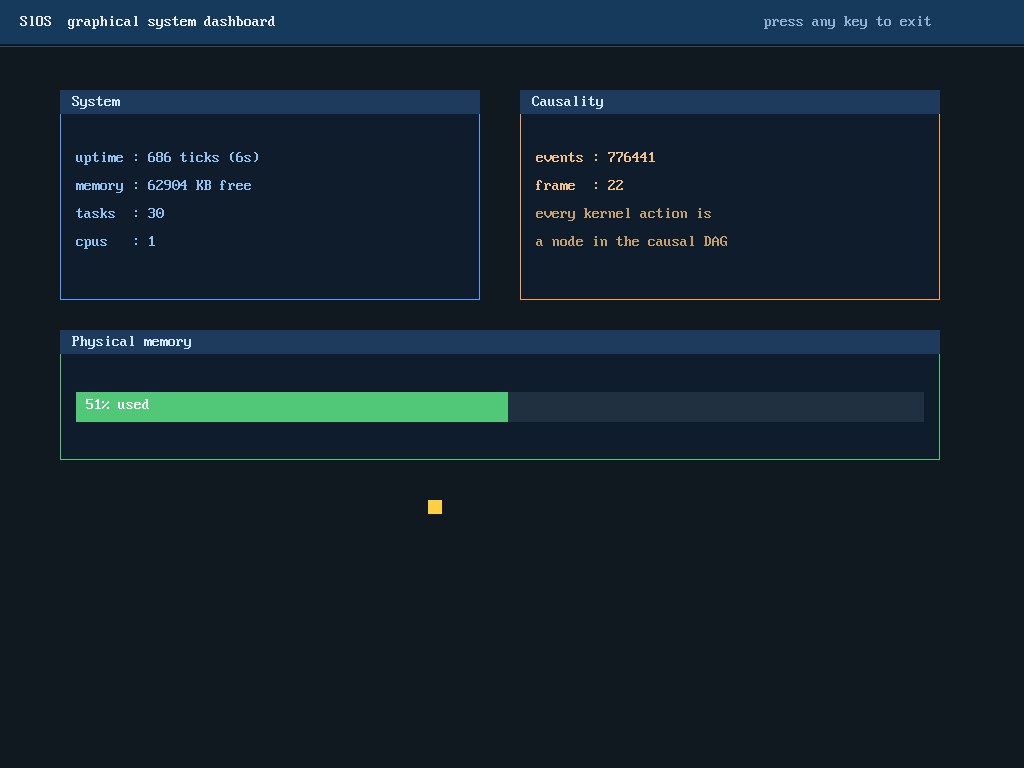
The wm command switches to the 1024x768x32 framebuffer and presents
a keyboard-driven desktop: live per-CPU status, causal event tail, task list,
and memory/system bars. It is still deliberately simple -- fixed tiled panels,
Tab focus, and q/Esc exit -- but it makes the causal
machine visible at a glance.
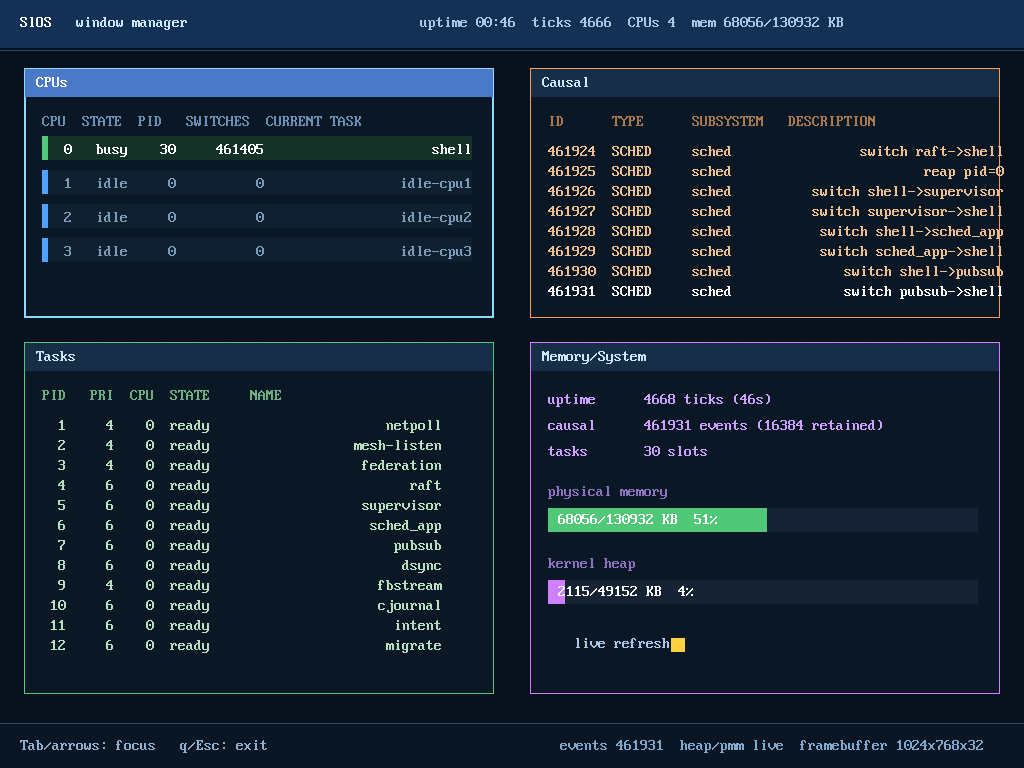
slos:/$ wm
SlOS WM: 1024x768 tiled desktop
Tab: focus next   q/Esc: exit

+ CPU monitor: CPU0..CPU3 active/current task/switches
+ Causal tail: live recent events
+ Task list: PID, state, priority, name
+ System: uptime, heap, frames, event ring bars
01 / Causal graph
Scheduler switches, syscalls, filesystem operations, packets, actor messages, mesh events, shell commands, and application events enter a typed DAG with Lamport time and parent edges.
02 / Durable history
cjournal spills aged events from the hot ring into SlFS segment files with per-event hashes, Merkle sidecars, epoch roots, and searchable indexes.
03 / Replay
rewind, replay, scrub, and whatif read the same event material. The Causal Inspector focuses the DAG, diffs two ticks, and reports counterfactual blast radius.
04 / Window manager
wm is a keyboard-driven tiled desktop on the 1024x768 framebuffer: CPU monitor, causal tail, task list, and memory/system panels in one inspectable screen.
05 / SMP
The BSP can auto-offload queued ap_offloadable kernel tasks to idle application processors. It is cooperative and kernel-task-only, not arbitrary load balancing.
06 / Web explorer + federation
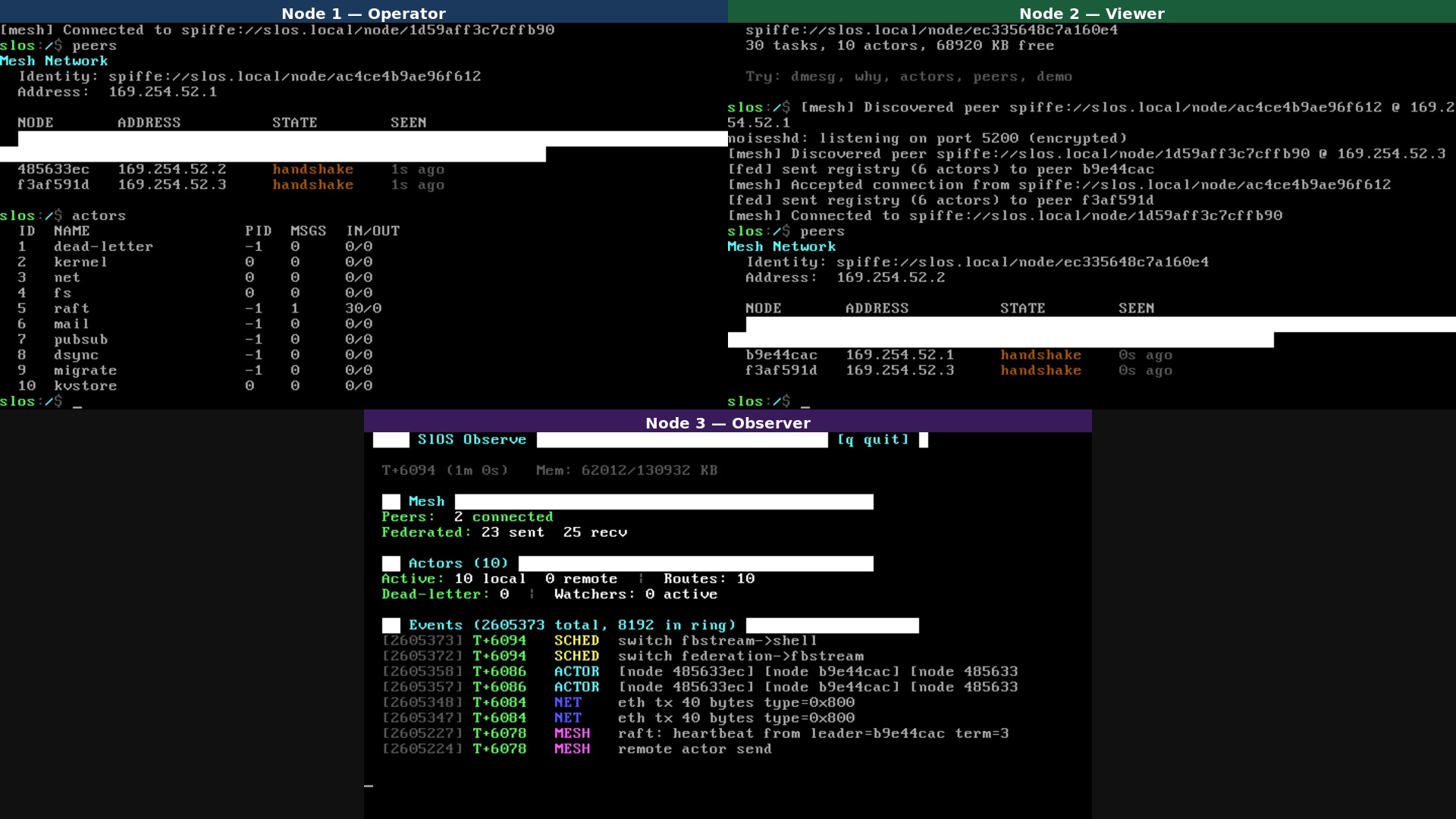
The userspace httpd exposes /causal, an interactive SVG DAG with a time-travel scrubber. Actors, Noise-encrypted mesh, and federation carry the same causal vocabulary between peers.
07 / Trust
A per-node Ed25519 key signs verified epoch roots. Over the encrypted mesh, peers exchange signing keys and signed roots; the receiver checks the signature against the peer key, so shared causal history is attributable to that node.
08 / Remote workstation
telnetd and a Noise-encrypted shell expose SlOS over TCP. A terminal-redirection layer carries the full-screen editor and ANSI apps over the wire, sized to your terminal via NAWS. Paths under /home persist, slosh has functions and recursion, and services you start survive disconnect.
Remote workstation
telnetd and a Noise-encrypted shell (noiseshd,
X25519 + ChaCha20-Poly1305) expose SlOS over TCP. A terminal-redirection
layer carries the full-screen edit editor and ANSI apps over the
connection, sized to your terminal through telnet NAWS. Paths under
/home persist to SlFS across reboot; slosh has grown
functions, recursion, and shell-command passthrough; and a service you start
in a session keeps running after you disconnect. It is telnet and a
from-scratch encrypted channel -- not OpenSSH -- and the machine is still a
single trust domain, but you can edit, run, and serve from your own keyboard.
host:$ telnet localhost 2323            # or the guest IP on port 23
slos:/$ uname
SlOS 0.1.0 (Slepp Operating System)  i686 x86
slos:/$ edit /home/proj/hello.sl        # full-screen editor, over the wire
slos:/$ run /home/proj/hello.sl
hello from a real SlOS day
slos:/$ httpd                           # start a background service
[httpd] Started (pid 35) -- http://localhost:8080/
slos:/$ exit                            # ...the server keeps running
host:$ curl http://localhost:8080/      # reachable after you disconnect
Flagship instrument
Start httpd inside SlOS and open /causal. The page renders
the live causal DAG as an in-browser SVG, laid out by causal depth and coloured
by event type. A slider reconstructs past system state at any tick. Clicking a
node highlights causes in blue and effects in yellow.
slos:/$ httpd
[httpd] Started (pid 18) — http://10.0.2.15/ (host: http://localhost:8080/)
[httpd] Listening on port 80 — dashboard at http://<ip>/

host:$ curl http://10.0.2.15/api/causal/state?tick=18400
{"tick":18400,"total_events":4218,"tasks":{"alive":9,"created":31,"exited":22},"io":{"syscalls":701,"fs":211,"net_tx":44,"net_rx":88,"actor_msgs":37},"active_tasks":[{"pid":31,"name":"shell"}],"recent_events":[4215,4216,4217,4218]}

host:$ curl http://10.0.2.15/api/causal/graph
{"nodes":[{"id":4219,"tick":18401,"type":"shell","subsystem":"shell","desc":"command: note add field report","remote":false}],"edges":[{"from":4219,"to":4220}]}

Open http://10.0.2.15/causal
live SVG DAG + time-travel scrubber + click-to-focus
SMP and live causality
smp offload <n> creates unpinned, AP-safe kernel tasks.
The BSP scheduler may retarget them to idle CPUs 1-3 and records the decision
as causal scheduler events. This is opt-in cooperative offload, not AP timer
preemption or user-task migration.
slos:/$ smp offload 6
created 6 AP-offloadable kernel tasks
[ap] task ran on CPU 1
[ap] task ran on CPU 2
[ap] task ran on CPU 3

slos:/$ cpu
CPU  ACTIVE  CURRENT       SWITCHES  STATE
0    yes     shell         1842      busy
1    yes     ap-demo       17        busy
2    yes     idle/2        14        idle
3    yes     idle/3        13        idle

slos:/$ cwatch tail
#8842 SCHED sched offload pid=47 to=cpu1
Learning routes
Each route starts with an operator surface, then names the source files that make the result possible. Causality is the preferred first route for this edition.
| Causality laboratory | Live ring, archived journal, CQ selectors, proofs, scrub, whatif, and the web DAG explorer. |
| Guided concept trails | Routes through boot, commands, causal graph inspection, replay, networking, and applications. |
| Subsystem chapters | Source paths, commands, dependencies, and operator watch points for each kernel area. |
| Source atlas | Files and listings for graph, journal, replay, shell, httpd, userspace, and drivers. |
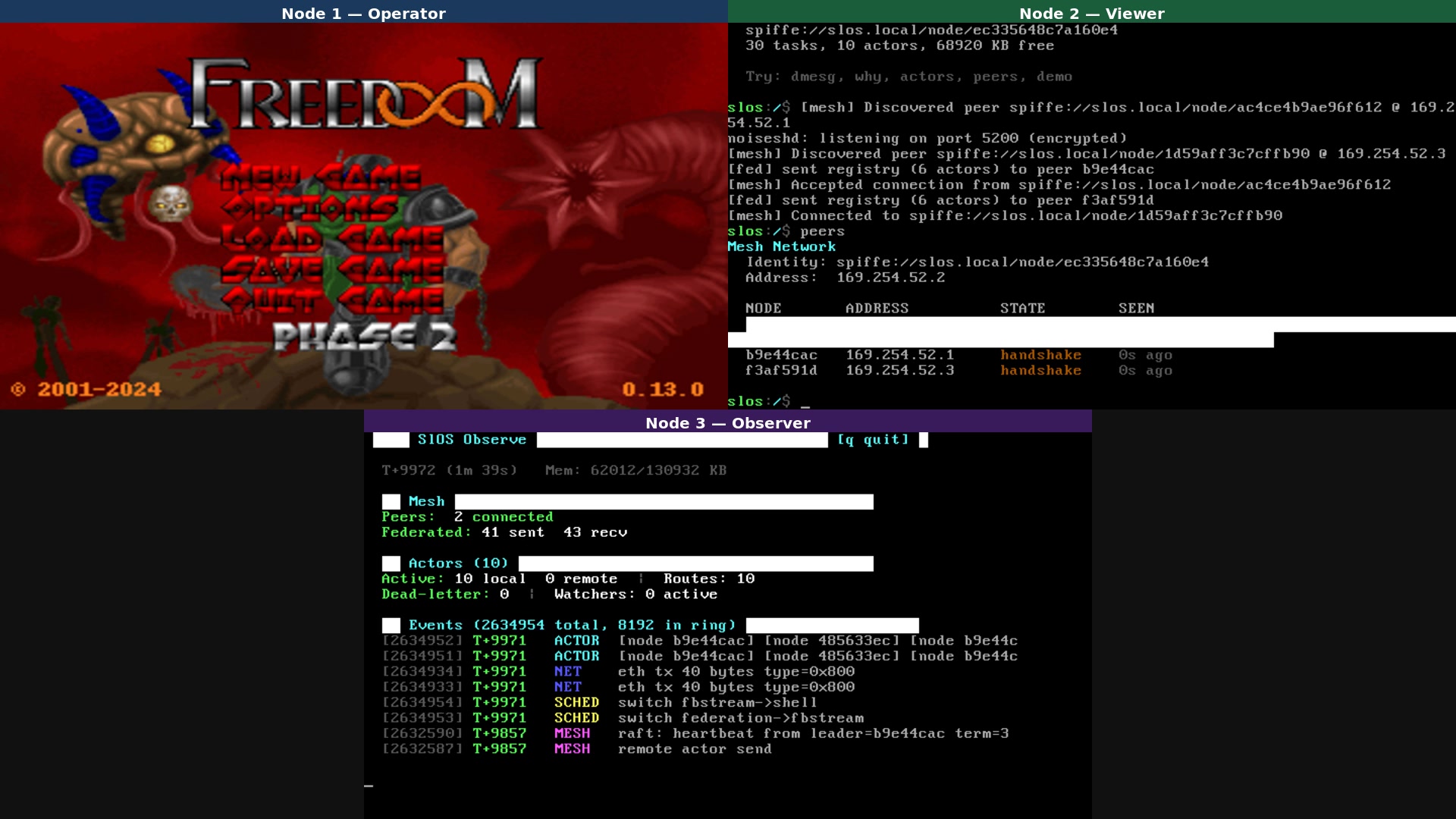
| Showcase plates | Boot, persistence, productivity, mesh, distributed DOOM, and graph-native applications. |
| Field manual | Continuous manual reading order for printing or long-form study. |
| Reading room | Research lineage: logical clocks, event sourcing, provenance, replay, actors, and limits. |
| Glossary | Operating-system and causal-graph terms mapped to SlOS commands and source files. |
System measurements
| Target | i686 bare metal; QEMU or hardware via Multiboot |
| Build | make, make run, make run-nographic |
| Hot causal ring | 16,384 live events |
| Event types | SCHED, MEM, FS, NET, SYSCALL, SHELL, ACTOR, MESH, IO, USER |
| Journal storage | SlFS /causal segments, 512 events each |
| Integrity | per-event hashes, Merkle sidecars, epoch proofs |
| Web surface | /causal and /api/causal/{state,recent,graph,dot} |
| SMP lane | 4 CPUs; cooperative auto-offload for ap_offloadable kernel tasks |
| Framebuffer UI | wm tiled desktop at 1024x768x32 |
| TCP services | httpd, telnetd :23, Noise-encrypted shell :5200, chatd :6667 |
| Remote workstation | full-screen editor over the wire, NAWS terminal sizing, daemon survival |
| Scripting | slosh: functions, recursion, for-loops, shell-command passthrough |
| Filesystem | coherent namespace; /home persists across reboot, /tmp is scratch |
| Applications | timelines, notes, mail, editor, scheduler, wm, DOOM |
System plate A
System plate B
events 10
why last
why --md last
why -a <event-id>
trace <event-id>
blast <event-id>
cpath <ancestor-id> <descendant-id>
cpath common <a> <b>
cdot last effects
journal stats
journal proof-health
cq -a type=fs desc~notes limit=5 -l
ctop 128
cwatch tail
cpu
smp offload 6
ps | grep shell
events | tail -n 5
chatd start
lens save fsnotes cq -a type=fs desc~notes limit=8
scrub event last
scrub whatif last
Live and archived query
slos:/$ events 6
  ID    TICK    TYPE        DESCRIPTION
  4219  18401   shell       command: note add field report
  4220  18401   fs          write /notes.db
  4221  18402   user        notes event appended
  4222  18402   syscall     write pid=31

slos:/$ why --md last
# Why event 4222
- **[4222]** syscall: write pid=31
  - **[4221]** notes: notes event appended
    - **[4220]** fs: write /notes.db

slos:/$ why -a 1042
Journal trace for #1042
  #1042 T+9112 shell command: wget /index.html
  #1040 T+9109 tcp rx ack
  #1036 T+9098 net packet rx
Durable journal
slos:/$ journal stats
Journal stats: 12288 persisted events by type
  sched    4180
  fs       2107
  net      903
  syscall  3721

slos:/$ cq -a type=fs desc~notes limit=3 -l
Event #3182
  Tick:      T+14211
  Type:      fs
  Source:    journal
  Segment:   00000006

slos:/$ journal proof-health
journal proof-health: PASS segments=24 hash=24/24 root=24/24
Time travel
slos:/$ scrub 18400
SlOS Causal Time-Travel  tick 18400 / 18402
[=======================================-]
Reconstructed state (replay of 4218 events):
  tasks: alive 9  created 31  exited 22
  io:    syscalls 701  fs 211  net tx/rx 44/88  actor msgs 37
Active tasks (9):
  [pid 31] shell
Recent events (8): #4215 #4216 #4217 #4218 #4219 #4220 #4221 #4222

slos:/$ scrub event last
Event #4222 focus
  type=SYSCALL subsystem=syscall tick=T+18402
  origin: node=0x0 (local)
  desc: write pid=31
Caused by (parents):
  #4221 notes: notes event appended
  #4220 fs: write /notes.db
Led to (effects):
  (no downstream effects)

slos:/$ scrub whatif last
whatif: drop #4222 (syscall) -> 0 events eliminated, verdict: NO IMPACTtypedef struct {
uint32_t id;
uint32_t node_hash;
causal_time_t time;
causal_type_t type;
char subsystem[16];
char desc[CAUSAL_DESC_LEN];
uint8_t payload[CAUSAL_PAYLOAD_LEN];
uint32_t payload_len;
uint8_t payload_hash[32];
bool payload_hash_valid;
uint16_t schema_id;
uint8_t schema_version;
uint32_t parents[CAUSAL_MAX_PARENTS];
uint8_t num_parents;
uint16_t child_count;
} causal_event_t;#define CJOURNAL_MAX_FILES 32
#define CJOURNAL_EVENTS_PER_FILE 512
#define CJOURNAL_DIR "/causal"
#define CJOURNAL_SPILL_THRESHOLD 12288
typedef struct __attribute__((packed)) {
uint32_t id;
uint32_t node_hash;
uint64_t lamport;
uint32_t wall_ticks;
uint8_t type;
char subsystem[16];
char desc[80];
uint32_t parents[4];
uint8_t num_parents;
uint16_t child_count;
uint32_t payload_len;
uint8_t payload_hash[32];
uint16_t schema_id;
uint8_t schema_version;
} cjournal_event_t;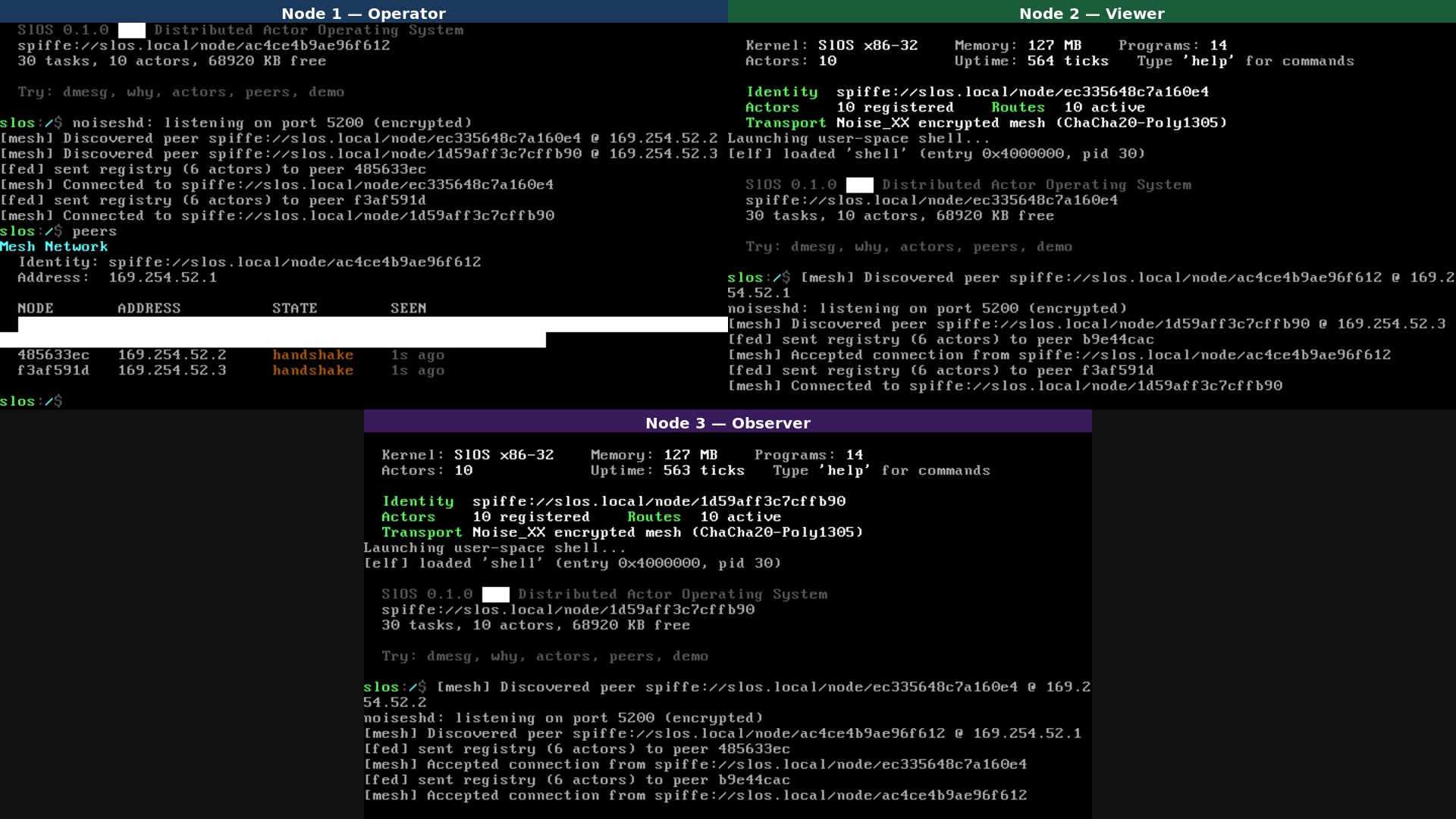
Operator quick start
git clone https://github.com/slepp/slos.git
cd slos
make
make run-nographic
The short claim
A bare-metal OS that serves a live, navigable, time-travelling picture of its own causality over HTTP. The page is not a simulation of the manual. It is a userspace program asking the kernel for its graph.